
How to Become an AI Generalist
A practical guide for students, freelancers, marketers, and professionals looking to build a future-ready AI career — no coding degree required.
● No coding needed ● Hyderabad focused ● Beginner friendly ● Real-world tools
Introduction
Artificial intelligence is no longer limited to software engineers or data scientists. Today, students, freelancers, marketers, business owners, and even non-technical professionals are learning AI tools to improve productivity and build future-ready careers.
That’s where the role of an AI generalist comes in.
If you’ve been exploring AI careers and wondering where to start, this guide will help you understand exactly how to become an AI generalist step-by-step—even if you are a complete beginner.
Across Hyderabad, Telangana, and other parts of India, companies are actively looking for professionals who can use tools like ChatGPT, Claude AI, Midjourney, automation platforms, and AI workflows to solve business problems.
The best part?
You do not need to become a hardcore programmer to enter this field.
In this article, you’ll learn:
- What an AI generalist actually does
- Skills required to build an AI career
- Best AI tools to learn
- Whether coding is necessary
- AI generalist salary trends in India
- Common mistakes beginners make
- A practical roadmap to get started
Whether you are a college student in Hyderabad, a freelancer in Kukatpally, or a working professional from Ameerpet looking to upgrade your skills, this guide is designed to make AI easy to understand.
What is an AI Generalist?
An AI generalist is a professional who understands multiple AI tools, workflows, automation systems, and practical AI applications across different industries.
Instead of specialising only in machine learning or coding, AI generalists focus on using AI tools effectively to improve productivity, automate tasks, create content, generate insights, and solve real-world business problems.
Think of an AI generalist as someone who can combine the following:
- Prompt engineering
- AI automation
- AI content creation
- Workflow optimization
- No-code AI tools
- Business problem-solving
- Generative AI applications
For example, an AI generalist might:
- Use ChatGPT to create marketing content
- Build automated workflows using AI tools
- Generate designs with Midjourney
- Create AI chatbots for businesses
- Use AI agents for customer support
- Automate repetitive office tasks
This role is becoming increasingly valuable because companies need people who can actually use AI in day-to-day operations— not just understand theory.
Real-World Example
Imagine a digital marketing agency in Hyderabad.
Instead of hiring separate people for:
- content writing,
- automation,
- AI research,
- chatbot setup,
- and productivity optimization,
They may hire one skilled AI generalist who can manage all these tasks efficiently using modern AI tool
That’s why the demand is growing rapidlys..
Why AI Generalists Are in Demand
An AI generalist combines:
Skills Required to Become an AI Generalist
You do not need to master everything at once.
A successful AI generalist usually develops a combination of practical, creative, and technical skills.
Prompt Engineering
Prompt engineering is one of the most important skills today. You should learn: how to write effective prompts, structure instructions, generate accurate outputs, and improve AI responses. This skill alone can dramatically improve productivity.
⚡ AI Tool Usage
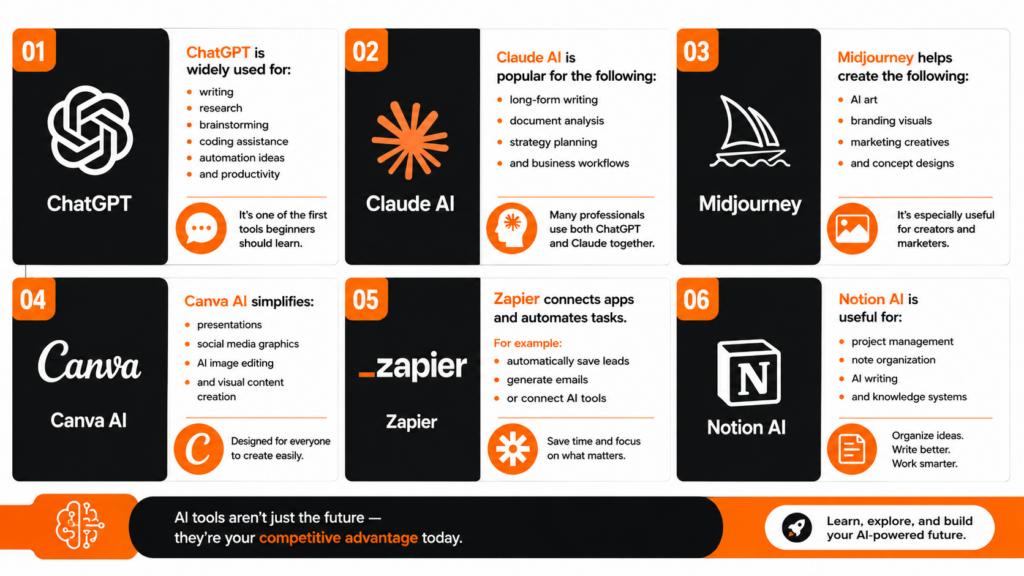
You should become comfortable using tools like the following: ChatGPT Claude AI Gemini Midjourney Canva AI Notion AI Perplexity AI Understanding how these tools work together is more important than memorizing features.
🎨 AI Automation
Automation is a major part of modern AI careers. Learn platforms like: Zapier Make.com n8n Pabbly Connect These tools help automate workflows without coding.
🔄Content Creation Skills
AI generalists often create the following: blogs, social media posts, videos, AI-generated visuals, marketing content, and presentations. Basic communication and storytelling skills are extremely useful.
🧩 Problem-Solving Ability
Businesses hire AI professionals to solve real problems. You should practice: identifying repetitive tasks, improving workflows, and creating practical AI solutions.
💡Basic Tech Understanding
While advanced coding is optional, understanding the following is essential: APIs, workflows, AI concepts, and digital tools can help you work more efficiently.
Best AI Tools Every AI Generalist Should Learn
The AI ecosystem changes quickly, but some tools are becoming essential.
Companies Need AI Adoption
Many businesses know AI is important but don't know how to use it. AI generalists help integrate tools, automate operations, save time, and reduce costs.
Generative AI Is Growing Fast
ChatGPT, Claude AI, Gemini, Midjourney, and Runway ML have changed how businesses work. Organizations need professionals who understand these workflows.
Skills Useful Across Industries
AI generalists are needed in marketing, education, healthcare, e-commerce, real estate, finance, startups, and freelancing.
No-Code Tools Lower the Bar
Earlier, AI careers required advanced coding. Now, beginners can build automations, AI agents, workflows, and chatbots without deep programming knowledge.
⚙️ Zapier
Automation · Integrations
📋 Notion AI
Notes · Projects · Writing
💎 Gemini
Research · Google Suite
🔍 Perplexity AI
Real-time Search · Research
ACTION PLAN
Step-by-Step Roadmap
Here’s a practical roadmap beginners can follow.
A practical path for beginners to follow, from zero to job-ready AI generalist.
Step 1: Understand AI Basics
Start with: what AI is, how generative AI works, common AI applications, and industry trends. Avoid jumping on advanced technical topics immediately.
Step 2: Learn Prompt Engineering
Spend time experimenting with prompts daily. Practice rewriting prompts, improving outputs, and comparing AI responses. This builds real-world AI communication skills.
Step 3: Learn Core AI Tools
Focus on 3–5 important tools initially. Recommended beginner stack: ChatGPT Claude AI Canva AI Midjourney Zapier Mastering a few tools is better than trying everything.
Step 4: Build Small AI Projects
Practical learning is critical. Try building: AI content systems, automated workflows, AI chatbots, productivity dashboards, or social media automations. Projects help you gain confidence.
Step 5: Learn AI Automation
Automation separates beginners from professionals. Practice: connecting apps, automating repetitive tasks, and building workflow systems.
Step 6: Create an Online Presence
Share: AI experiments, productivity tips, AI tutorials, and automation workflows. Platforms like LinkedIn and Instagram can help build visibility.
Step 7: Join a Community or Training Program
Learning alone can become confusing. A structured AI generalist course can help: avoid information overload, build practical skills, and gain mentorship. Many learners in Hyderabad now prefer hands-on AI tools training instead of purely theoretical programs.
COMMON QUESTION
Do You Need to Code?
Short answer: No, not necessarily. Many AI generalists work successfully using no-code AI tools and automation platforms without becoming software engineers.
You can build automations, AI workflows, chatbots, content systems, and productivity solutions without coding. However, basic coding knowledge can be helpful later — understanding APIs, editing simple scripts, or customizing automations can unlock more advanced work.
Beginners should not delay learning AI just because they cannot code. Today’s AI ecosystem is far more accessible than before.
OPPORTUNITIES
Career Paths for AI Generalists
AI generalists can work across multiple roles and industries, with growing demand both in traditional employment and freelancing.
📝 AI Content Specialist
Creates AI-assisted content for brands and businesses.
🎯 Prompt Engineer
Designs optimized prompts for AI systems and products.
⚙️ AI Automation Specialist
Builds automated business workflows and integrations.
🤝 AI Consultant
Helps companies adopt and implement AI tools strategically.
📈 AI Marketing Specialist
Uses generative AI for digital marketing campaigns.
💼 AI Freelancer
Provides AI services independently — content, chatbots, automation.
COMPENSATION
Salary Trends in India
AI careers are growing rapidly in India. Salaries depend on experience and skill level. Cities like Hyderabad, Bengaluru, Pune, and Gurgaon are seeing the fastest growth.
| Experience Level | Estimated Salary Range |
|---|---|
| Beginner | ₹3 LPA – ₹6 LPA |
| Intermediate | ₹6 LPA – ₹12 LPA |
| Advanced | ₹12 LPA – ₹25 LPA+ |
Freelancers and consultants may earn differently depending on projects, clients, niche expertise, and automation skills.
PITFALLS
Common Mistakes Beginners Make
🔴 Trying Too Many Tools at Once
Learning 20 tools simultaneously creates confusion. Focus on mastering a small set first before expanding.
🔴 Watching Tutorials Without Practice
Passive learning doesn't build skills. Real growth happens through projects and experimentation.
🔴 Ignoring Prompt Engineering
Good prompts produce dramatically better results. This is one of the highest-value skills in AI today.
🔴 Expecting Instant Results
AI careers still require consistency and practice. There is no shortcut to becoming genuinely skilled.
🔴 Learning Only Theory
Businesses care about implementation. Practical AI workflows matter far more than memorized definitions.
FAQ
Frequently Asked Questions
An AI generalist is someone who understands multiple AI tools, workflows, automation systems, and practical AI applications across industries — without necessarily being a deep technical specialist.
Yes. AI generalist roles are growing rapidly because businesses need professionals who can practically implement AI tools and automation systems across everyday operations.
Beginners can develop foundational AI skills within 3–6 months with consistent practice and project-based learning. The key is daily experimentation over passive watching.
No. Many AI generalists use no-code AI tools and automation platforms without advanced programming knowledge. Basic coding can be helpful later, but it is not a requirement to start.
Start with ChatGPT, Claude AI, Canva AI, Midjourney, Zapier, and Notion AI. Master 3–5 tools well before branching out to more advanced platforms.
Yes. Many AI tools are beginner-friendly and specifically designed for non-technical users. Students from any background can start learning AI tools and build practical skills.
Ready to Start Your AI Journey?
Whether you are a student in Hyderabad, a freelancer in Telangana, or a working professional anywhere in India — this is one of the best times to explore AI career opportunities.
© 2025 AI Generalist Academy · Hyderabad, Telangana, India
Practical AI Training for the Next Generation of Professionals
How to Become an AI Generalist
Artificial intelligence is no longer limited to software engineers or data scientists. Today, students, freelancers, marketers, business owners, and even non-technical professionals are learning AI tools to improve productivity and build future-ready careers.
That’s where the role of an AI generalist comes in.
If you’ve been exploring AI careers and wondering where to start, this guide will help you understand exactly how to become an AI generalist step-by-step—even if you are a complete beginner.
Across Hyderabad, Telangana, and other parts of India, companies are actively looking for professionals who can use tools like ChatGPT, Claude AI, Midjourney, automation platforms, and AI workflows to solve business problems.
The best part?
You do not need to become a hardcore programmer to enter this field.
In this article, you’ll learn:
- What an AI generalist actually does
- Skills required to build an AI career
- Best AI tools to learn
- Whether coding is necessary
- AI generalist salary trends in India
- Common mistakes beginners make
- A practical roadmap to get started
Whether you are a college student in Hyderabad, a freelancer in Kukatpally, or a working professional from Ameerpet looking to upgrade your skills, this guide is designed to make AI easy to understand.
What is an AI Generalist?
An AI generalist is a professional who understands multiple AI tools, workflows, automation systems, and practical AI applications across different industries.
Instead of specialising only in machine learning or coding, AI generalists focus on using AI tools effectively to improve productivity, automate tasks, create content, generate insights, and solve real-world business problems.
Think of an AI generalist as someone who can combine the following:
- Prompt engineering
- AI automation
- AI content creation
- Workflow optimization
- No-code AI tools
- Business problem-solving
- Generative AI applications
For example, an AI generalist might:
- Use ChatGPT to create marketing content
- Build automated workflows using AI tools
- Generate designs with Midjourney
- Create AI chatbots for businesses
- Use AI agents for customer support
- Automate repetitive office tasks
This role is becoming increasingly valuable because companies need people who can actually use AI in day-to-day operations— not just understand theory.
Real-World Example
Imagine a digital marketing agency in Hyderabad.
Instead of hiring separate people for:
- content writing,
- automation,
- AI research,
- chatbot setup,
- and productivity optimization,
They may hire one skilled AI generalist who can manage all these tasks efficiently using modern AI tools.
That’s why the demand is growing rapidly.
Why AI Generalists Are in Demand
The AI industry is evolving faster than traditional education systems.
Businesses today want practical AI implementation — not just academic knowledge.
Here are the biggest reasons why AI generalists are in high demand:
1. Companies Need AI Adoption
Many businesses know AI is important but do not know how to use it effectively.
AI generalists help companies.
- integrate AI tools,
- automate operations,
- save time,
- reduce costs,
- and improve productivity.
2. Generative AI Is Growing Fast
- Tools like: ChatGPT
- Claude AI
- Gemini
- Midjourney
- Runway ML
- has changed how businesses work. Organisations now need professionals who understand generative AI workflows and practical implementation.
3. AI Skills Are Useful Across Industries
AI generalists are needed in the following:
- marketing
- education
- healthcare
- e-commerce
- real estate
- finance
- startups
- freelancing
- consulting
This flexibility makes AI a strong career option.
4. No-Code AI Tools Are Making Entry Easier
Earlier, AI careers required advanced coding.
Now, many no-code AI tools allow beginners to build the following:
- AI automations
- AI agents
- AI workflows
- chatbots
- AI content systems
without deep programming knowledge.
5. Businesses Want Productivity Experts
AI is not only about technology.
It’s also about:
- improving efficiency,
- reducing repetitive work,
- and scaling operations.
That’s why AI productivity experts are becoming valuable assets.
Skills Required to Become an AI Generalist
You do not need to master everything at once.
A successful AI generalist usually develops a combination of practical, creative, and technical skills.
Prompt Engineering
Prompt engineering is one of the most important skills today. You should learn:
- how to write effective prompts,
- structure instructions,
- generate accurate outputs,
- and improve AI responses.
This skill alone can dramatically improve productivity.